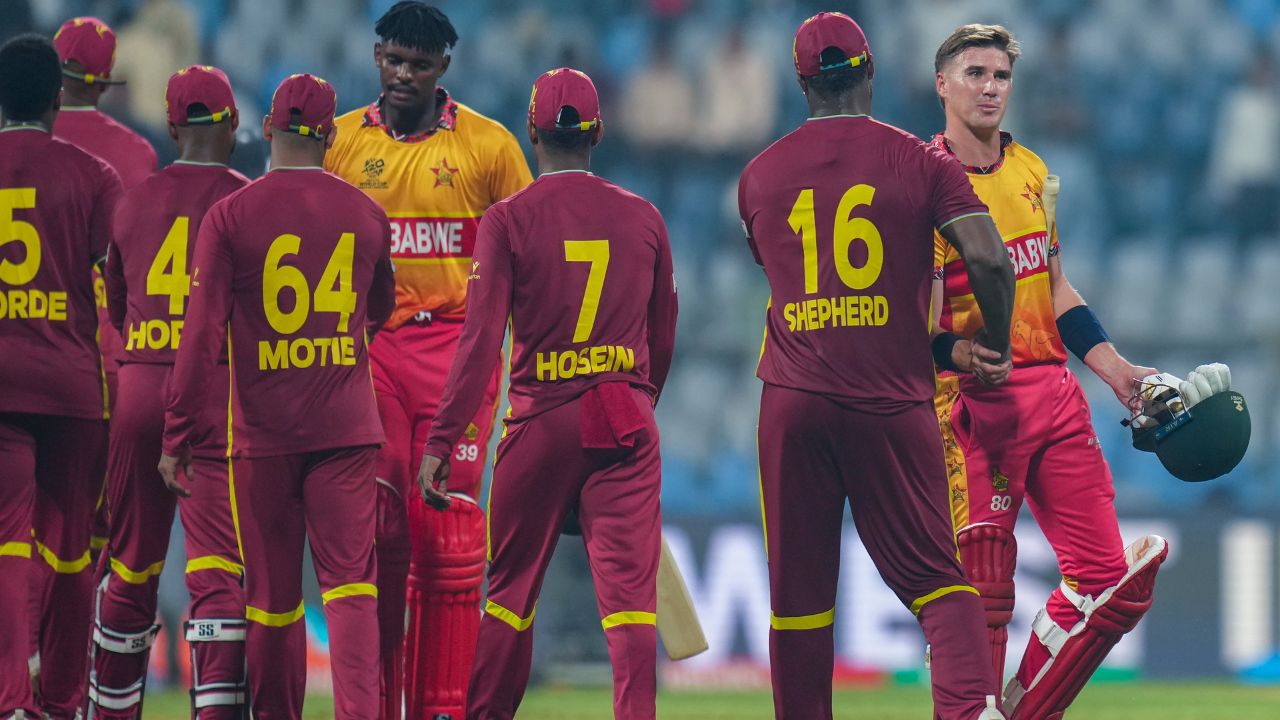
The ICC Men's T20 World Cup Super Eights stage witnessed a spectacular display of power-hitting and strategic dominance as the West Indies cricket team steamrolled Zimbabwe, securing a resounding 107-run victory. This clash, held on Monday, 23rd February 2026, in Mumbai, showcased the Caribbean side's formidable prowess, particularly with the bat, setting a new benchmark for team totals in the tournament. The comprehensive win not only bolstered the West Indies' position in Group 1 but also sent a clear message to their competitors about their title aspirations.
From the moment they were sent in to bat, the West Indies Blast 254/6, Crush Zimbabwe in T20 World Cup, demonstrating an aggressive intent that Zimbabwe simply couldn't contain. The performance was a testament to their adaptability and the explosive talent within their ranks, fundamentally altering the trajectory of their Super Eights campaign.
Hetmyer's Blitz and West Indies' Batting Masterclass
The architect of West Indies' colossal total was none other than Shimron Hetmyer, who delivered an innings that will be etched in T20 World Cup folklore. Blasting an incredible 85 runs off just 34 deliveries, Hetmyer registered the fastest fifty for the West Indies in T20 World Cup history. His breathtaking knock, adorned with seven towering sixes and seven punishing fours, was the cornerstone of their innings. This wasn't merely a good innings; it was a statement of intent, a display of pure, unadulterated T20 batting at its finest.
Crucially, Hetmyer's innings wasn't without its early reprieves. He was dropped twice by Tashinga Musekiwa when on single digits – a mistake that Zimbabwe would come to regret profoundly. As the old adage goes, "catches win matches," and in this instance, dropped catches arguably lost Zimbabwe the match before they even began their chase. Had that first chance been taken, the narrative of the match, and perhaps even the tournament, could have been dramatically different.
Hetmyer found an equally destructive partner in captain Rovman Powell, who contributed a brisk 59 runs. Their partnership of 122 runs off just 52 balls was an exhibition of audacious power-hitting, dismantling the Zimbabwean bowling attack piece by piece. Even after their departure, the onslaught continued with Sherfane Rutherford adding 31 and Romario Shepherd chipping in with 21, ensuring the scoreboard kept ticking at an alarming rate. The West Indies eventually posted a gargantuan 254 for 6, the second-highest team total in the history of the T20 World Cup and the highest in this edition so far, surpassing Ireland's 235/5.
Key Batting Highlights and Tactical Notes
- Capitalizing on Reprieves: Hetmyer's ability to maximize the dropped catches underscores the mental fortitude required at the highest level. It's not just about talent, but also about seizing second chances.
- Partnership Dominance: The 122-run stand between Hetmyer and Powell highlighted the importance of sustained partnerships in T20s, especially when one batter is in a destructive mood. It allows the pressure to build on the fielding side relentlessly.
- Wankhede's Batting Paradise: The Wankhede Stadium in Mumbai, known for its true surfaces and shorter boundaries, played perfectly into the West Indies' aggressive batting style. Adapting quickly to such conditions is vital for any team aspiring for glory.
- The Power-Hitting Blueprint: The West Indies showcased a blueprint for attacking T20 cricket – lose early wickets but maintain aggression, build a dominant middle-overs partnership, and finish with a flourish. This strategy can be devastating on flat pitches.
Zimbabwe's Uphill Battle: Adapting to the Conditions
In stark contrast to the West Indies' batting fireworks, Zimbabwe found themselves grappling with unfamiliar conditions and an unrelenting opposition. Having played all their previous matches in Sri Lanka, where pitches tend to be slower and offer more to spinners, the move to Mumbai's truer, batting-friendly surface proved to be a significant challenge for their bowlers. Blessing Muzarabani, consistent throughout the tournament, was a bright spot with his early spells, but the support he needed never materialized.
Richard Ngarava struggled to hit his mark, and the spinners, including the usually reliable Sikandar Raza, found it exceedingly difficult to build any sustained pressure. Raza, in particular, proved to be very expensive, unable to stem the flow of runs against the rampaging West Indies batsmen. Barring Muzarabani and Graeme Cremer, who managed to extract a modicum of turn, Zimbabwe's bowling attack appeared out of sorts, unable to find the rhythm or variations necessary to contain such an aggressive batting lineup.
Chasing 255 runs is a daunting task for any team, let alone one that hasn't fully adapted to the conditions. Zimbabwe's chase never truly took off, despite a valiant effort from No. 8 batter Brad Evans, who top-scored with a 21-ball 43. While Evans provided a late surge of hope, the required run rate was astronomical, and the consistent fall of wickets prevented any meaningful pursuit. The weight of the target, coupled with a Zimbabwean skipper nursing a finger injury and a reliance on Brian Bennett at the top, proved too much to overcome. They ultimately folded for 147 in 17.4 overs, falling short by a massive 107 runs.
The Cost of Fielding Errors in T20s
The impact of fielding cannot be overstated in T20 cricket, especially in high-stakes matches like the Super Eights. The dropped catches of Shimron Hetmyer by Tashinga Musekiwa serve as a stark reminder of how quickly the momentum can swing. In a format where every run, every ball, and every opportunity counts, fielding errors can:
- Boost Opposition Confidence: Allowing a dangerous batsman a second life can infuse them with confidence, making them even harder to dismiss.
- Increase Pressure on Bowlers: Bowlers toil hard for wickets, and when chances are put down, it's demoralizing and forces them to bowl more overs under intense pressure.
- Inflate Target Scores: A single dropped catch of a set batsman can easily lead to an extra 20-30 runs, which often proves to be the difference between a chaseable and an unchaseable total.
- Shift Momentum: A sharp catch can uplift an entire team, while a dropped one can cast a pall over the fielding side, impacting their energy and focus.
West Indies' Clinical Bowling Performance
With an imposing total on the board, the West Indies' bowlers had the luxury of aggression, and they seized the opportunity with both hands. The spin duo of Gudakesh Motie and Akeal Hosein proved to be Zimbabwe's tormentors, sharing an impressive seven wickets between them. Motie led the charge with a fantastic spell of 4 for 28, while Hosein complemented him perfectly with 3 for 28.
Their disciplined yet attacking bowling ensured that Zimbabwe could never build any significant partnerships or gain any momentum in their chase. Despite Brad Evans' late resistance, the consistent breakthroughs from the West Indies' spinners kept the pressure firmly on the Zimbabwean batsmen. This dominant Hetmyer's Record Blitz Powers West Indies Over Zimbabwe match was rounded off by a clinical bowling display, demonstrating the depth and balance of the West Indies squad.
Strategic Bowling in High-Pressure Chases
- Early Breakthroughs: Getting wickets in the Powerplay is crucial to derail a high-target chase. West Indies bowlers, though not bagging a huge number early, ensured no partnerships could develop.
- Spinners' Role on Flat Tracks: While Wankhede favours batsmen, quality spinners like Motie and Hosein can still thrive by bowling tight lines, using variations, and exploiting any turn available, forcing batsmen into errors.
- Maintaining Pressure: Even with a massive total, complacency can creep in. West Indies bowlers maintained intensity, ensuring Zimbabwe never got comfortable, taking wickets consistently to prevent any resurgence.
- Targeting Weaknesses: Identifying which batsmen are struggling with the conditions or under pressure and consistently targeting them can yield significant results.
In conclusion, the West Indies' emphatic 107-run victory over Zimbabwe in the T20 World Cup Super Eights was a powerful demonstration of their cricketing might. Shimron Hetmyer's record-breaking century laid the foundation for an intimidating total, beautifully complemented by Rovman Powell's aggression and strong contributions from the lower order. Zimbabwe, hampered by a lack of adaptation to the Mumbai conditions and crucial dropped catches, simply could not mount a challenge. The clinical bowling performances of Gudakesh Motie and Akeal Hosein then sealed the deal, underlining West Indies' status as serious contenders. This win for the West Indies in their Super Eights journey for west indies zimbabwe cricket action sets a high bar and provides valuable momentum as they progress deeper into the tournament, leaving Zimbabwe to reflect on what might have been had those early chances been taken.